
EDICOLA

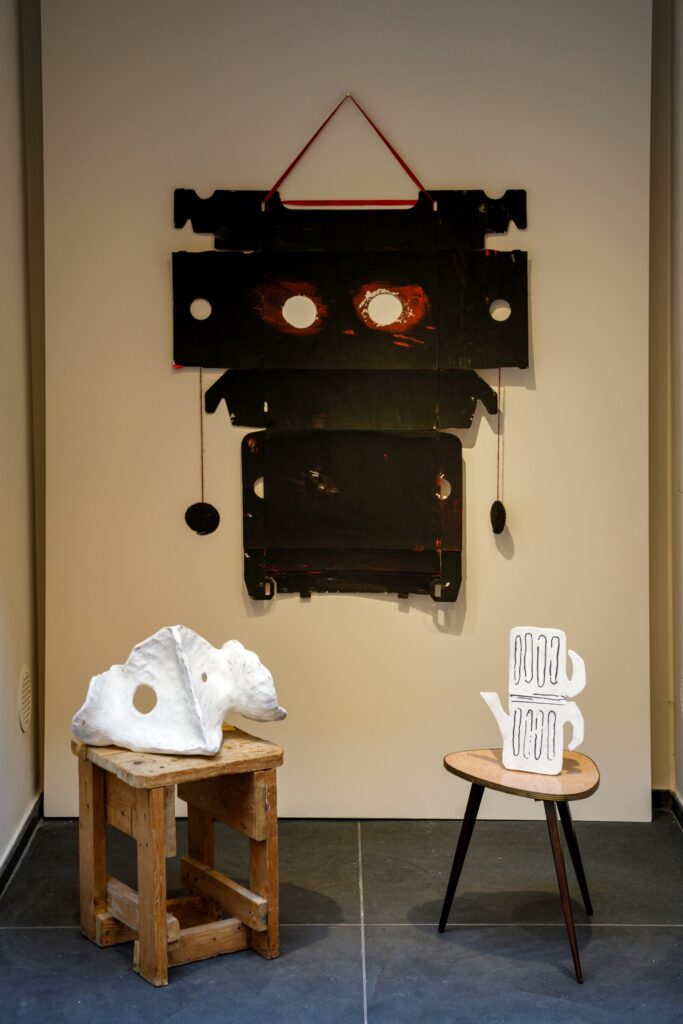
The site-specific installation takes the form of a collection of elements that seem to belong to different times and systems, yet which share the same space without ever coalescing into a single narrative. Recognisable objects and indecipherable forms coexist in a precarious balance, creating a state of constant interrogation.
The suspended black box appears simultaneously as a surface, a mask, a body or a relic. Its material origin remains perceptible, yet it is stripped of its function to take on another dimension, suspended between memory and transformation. The white forms introduce further shifts: they may evoke artefacts, organic fragments, domestic objects or unknown presences, without definitively corresponding to any of these possibilities.
The work unfolds like an open-ended puzzle, in which each element seems to suggest different meanings without ever being confined to a single interpretation. What emerges is not so much a representation as an experience of oscillating between recognition and bewilderment. The viewer is invited to engage with forms that appear both familiar and alien, capable of triggering personal associations, cultural memories and contrasting imaginaries. In this tension between the material and the symbolic, between concrete presence and mental projection, the work creates a space of fertile doubt. The forms offer not answers but possibilities; they do not describe a defined reality, but suggest constant shifts in meaning. The work thus becomes a device for interpretation, a place where what is observed coincides only partially with what one believes one sees.

Tre in uno (untitled, cardboard mask, 79x68 cm, 2020; untitled, terracotta, 19.5x34.5x21 cm, 2025; untitled, terracotta, 22x17x7.5 cm, 2025), 2026 © Danilo Donzelli Photography